0%

Choosing an Aluminum Window in 2026 means matching the opening to the building, climate, and daily use. A wide living-room opening may suit a sliding system, while a casement can direct fresh air into a smaller room. Tilt-and-turn designs offer flexible ventilation, and fixed windows bring daylight where opening is unnecessary. There is no universal winner. The right choice depends on details buyers can easily overlook.

Architect Ludwig Mies van der Rohe is often credited with saying, “God is in the details.” That design principle applies well to window selection: inspect frame joints, drainage paths, hardware, and seals, not just the finish. Thermal breaks can reduce heat transfer through aluminum frames, but performance also depends on glazing, installation, and the surrounding wall. A clean sample corner on a showroom table cannot reveal how a frame will perform through years of rain, sun, and daily operation.

This guide compares leading aluminum window types for global buyers, including sliding, casement, awning, tilt-and-turn, and fixed designs. It also considers thermal performance, opening space, maintenance, and project suitability. Ask suppliers for test data and clear product specifications. Look closely at the warranty. Still, specifications do not tell the whole story; installation quality can vary, and regional climate differences complicate comparisons. That is worth remembering before choosing by appearance alone.
2026 Top Aluminum Window Types for Global Buyers?

Aluminum Window Fundamentals: Profiles, Alloys, and Whole-Window Uw

Aluminum Window Fundamentals: Profiles, Alloys, and Whole-Window Uw

An aluminum window’s thermal performance starts with its profile, not just its glass. Aluminum conducts heat readily, so an unbroken frame can create a cold path from outdoors to indoors. Thermal breaks—often insulating strips between exterior and interior aluminum—interrupt that path. Look closely at corners, meeting rails, and frame depth; these details can affect both heat flow and air sealing. Small details matter.

Alloy selection influences extrusion strength, corrosion resistance, and how finely a profile can be shaped. It does not, by itself, determine insulation performance. A slim profile may admit more glass, but a narrow glazing pocket can limit glass-unit options. That trade-off is easy to underestimate. It deserves a second look.

Compare whole-window Uw, not center-of-glass values alone. Uw includes the frame, glazing, and their interaction; lower values indicate less heat transfer. The U.S. Department of Energy’s Energy Saver guidance estimates that windows account for 25–30% of residential heating and cooling energy use. That makes frame performance more than a specification detail. The National Fenestration Rating Council’s product-rating framework likewise evaluates the complete window, helping buyers compare tested products on a consistent basis. Ask for the rated size and configuration: changing dimensions, glass, or hardware can change performance. A strong glass unit cannot fully compensate for a poorly designed frame.

Top Types Compared: Casement, Sliding, Tilt-Turn, Awning, and Fixed

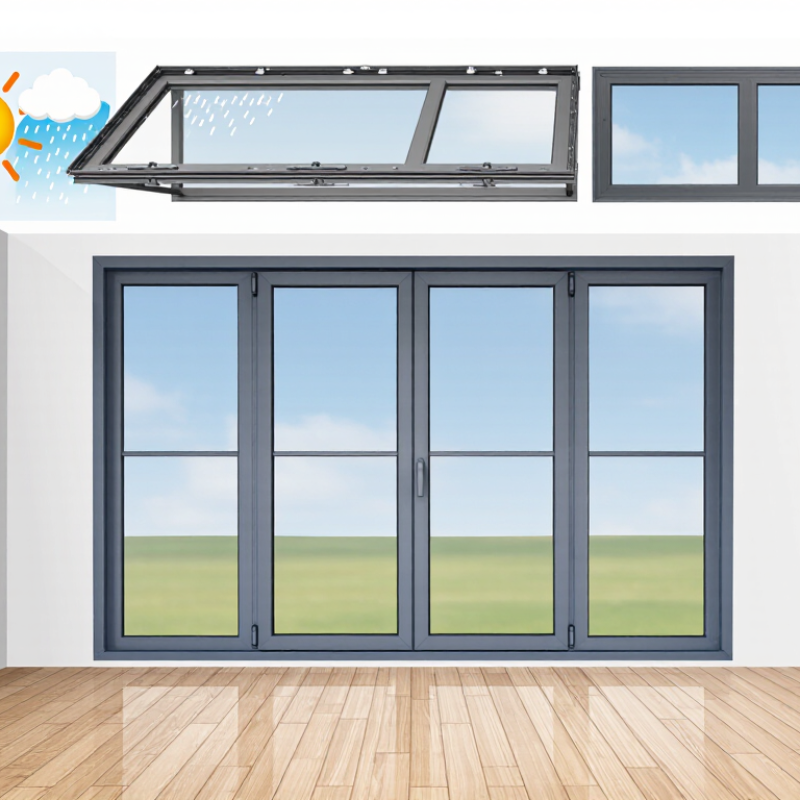
Casement windows hinge outward and close against a compression seal, making them useful where controlled ventilation and a tight shut line matter. Sliding windows need less clearance outdoors, but their tracks collect grit and may feel less airtight over time. Tilt-turn units offer two opening modes: tilt for gentle ventilation, turn for wider access. Handy, but heavier hardware and careful adjustment are essential. Awning windows open outward from the top, allowing some ventilation during light rain. Fixed windows provide daylight without ventilation and often deliver the simplest weather seal.

Frame choice changes the comparison. Aluminum is strong and supports slim sightlines, yet metal conducts heat readily; a thermal break helps limit transfer. The U.S. Department of Energy’s Energy Saver guidance estimates that heat gain and loss through windows account for about 25–30% of residential heating and cooling energy use. That figure concerns windows overall, not aluminum types alone. Check product-specific U-factor and solar heat gain coefficient ratings, such as those documented by the National Fenestration Rating Council, rather than judging by frame material. Small details matter. A casement may suit a breezy kitchen, while a fixed pane may better frame a view. The awkward part: the “best” type depends on climate, room use, cleaning access, and installation quality—and buyers sometimes overlook the last one.

2026 Top Aluminum Window Types for Global Buyers? — Top Types Compared: Casement, Sliding, Tilt-Turn, Awning, and Fixed
Window Type How It Opens Ventilation Space & Access Typical Strengths Key Considerations Common Applications
Casement Hinged at the side; the sash swings outward or inward, depending on the design. Wide opening; airflow can be directed into the room when the sash is positioned to catch a breeze. Needs clearance on the opening side. Outward-opening versions may be restricted by walkways, shutters, or adjacent structures. Provides a broad opening and can press against perimeter seals when closed. Hardware and sash design affect operation and sealing. Check wind exposure, opening direction, hardware capacity, and safe access for cleaning. Bedrooms, living areas, and locations where a clear, wide opening is useful.
Sliding One or more sashes move horizontally along tracks. Usually opens part of the window area; the available ventilation depends on the number and configuration of moving panels. Does not swing into or out of the room, making it useful where clearance is limited. Convenient operation and an unobstructed area around the window; suitable for wide openings. Tracks need periodic cleaning. The moving panel generally cannot open the entire frame width, and performance depends on the track, rollers, and seals. Patios, balconies, living spaces, and wide wall openings.
Tilt-Turn Typically tilts inward at the top for limited ventilation and swings inward from the side for a wider opening. Offers a small top opening or a larger full-opening mode. Requires interior clearance when swung fully open; the tilt mode uses less room. Two opening modes in one sash; inward operation can make access for cleaning easier where the exterior is reachable from indoors. Uses more complex hardware than a basic single-mode window. Confirm handle operation, room clearance, and hardware maintenance requirements. Homes and buildings where controlled ventilation and inward access are priorities.
Awning Hinged at the top; the bottom of the sash swings outward. Provides ventilation through the lower opening while the sash projects outward. Needs exterior clearance. Its position may make it unsuitable above busy paths or where it could obstruct movement. Can provide ventilation during light rain when the window, opening, and exposure are suitable. Rain protection is not guaranteed in severe weather or every installation. Consider wind exposure, drainage, and safe cleaning access. Bathrooms, basements, and higher-level openings, often paired with fixed glazing.
Fixed Does not open. None; ventilation must come from other operable windows or a separate ventilation system. No opening clearance is needed. Large units may require careful planning for delivery, installation, and replacement access. Provides daylight and views without operating hardware; can be used to create large glazed areas. Cannot provide natural ventilation or serve as an opening for emergency escape. Glass selection and installation affect safety and performance. Picture windows, curtain-wall-style layouts, and combinations with operable units.

Selection note: Performance varies with frame design, glazing, seals, hardware, fabrication, installation, and local climate. Confirm applicable building, safety, energy, and wind-load requirements for the project location.

Opening Styles and Use Cases: Ventilation, Views, and Space Requirements

Casement windows suit rooms that need directed airflow. Their hinged sashes can catch cross-breezes, but they need clear exterior swing space. Awning windows open outward from the bottom and can admit air during light rain. Sliding windows save space beside patios and walkways, though only part of the frame opens. For compact rooms, tilt-turn designs offer controlled ventilation, but inward-opening panels may conflict with curtains or furniture. There is no perfect opening style.

Tips: Stand beside the planned window and check the sash path. Picture a chair, a curtain, and a rainy afternoon. Small details matter.

Views, ventilation, and energy performance should be considered together. The U.S. Department of Energy’s Energy Saver guidance estimates that windows account for 25–30% of residential heating and cooling energy use. That figure makes frame quality, glazing, and installation worth checking—not just the opening mechanism. In warm climates, a wide operable sash may help capture breezes; in noisy or dusty locations, frequent opening may be less practical. A larger glass area can brighten a room, yet still feel uncomfortable without suitable shading. Product performance varies, so compare tested specifications and reflect on how the room is actually used.

Thermal Breaks and Glazing: Compare Uw (W/m²·K) and SHGC

2026 Top Aluminum Window Types for Global Buyers?

Thermal breaks and glazing should be compared together, not as separate upgrades. Uw measures heat transfer through the complete window; lower values mean better insulation. SHGC shows how much solar heat enters through the glass, on a scale from zero to one. For example, a specification of Uw 1.2 W/m²·K and SHGC 0.35 describes a different balance from Uw 1.6 and SHGC 0.55. These are comparison examples, not universal targets. A thermally broken frame interrupts heat flow through aluminum, but the glass area, spacer, and installation also affect the final rating. Small details matter.

Climate changes the better choice. In cold regions, a lower Uw can help limit heat loss; in hot, sunny locations, a lower SHGC can reduce unwanted solar gain. The U.S. Department of Energy’s Energy Saver guidance reports that low-emissivity coatings can reduce window energy loss by 30% to 50%. Yet coatings and low SHGC can also reduce useful winter sun or visible light. There is a trade-off. Check whole-window ratings from a recognized certification label, and compare identical sizes and configurations. A glass-only value may look impressive while the assembled window performs less well. Orientation matters, too: afternoon sun on a west-facing room can make a moderate SHGC feel like the wrong choice. Even careful specifications need a reality check against local weather and actual room use.

Global Test Ratings: EN 12207 Class 4, EN 12208 Class 9A (600 Pa), EN 12210 C5 (2,000 Pa)

For global buyers comparing aluminum window types in 2026, test ratings can reveal more than frame appearance.

EN 12207 Class 4 indicates the tested window achieved the standard’s highest air-permeability class. That matters in exposed rooms, where drafts can make a seating area feel cold even when heating is on. Look for the rating on the exact window configuration, not just a product family.

EN 12208 Class 9A at 600 Pa describes strong resistance to water penetration under the test procedure.

EN 12210 C5, reported at 2,000 Pa, signals high wind-load performance; the “C” also identifies a stricter deflection category.

These figures are useful, but they are not a promise of identical results in every building. Size, opening style, seals, hardware, and installation all affect real-world performance. A large sliding unit may behave differently from a compact casement, even when both use aluminum frames. Ask for the test report and check that its dimensions and opening type match your specification.

Small detail. Also check drainage paths and corner joints. A good rating can still disappoint if fitting leaves gaps or blocks water outlets. That distinction is easy to overlook, and it deserves a second look.

FAQS

Which window type may suit a breezy kitchen?

A casement opens outward and closes against a compression seal. It allows controlled ventilation and a tight shut line. Check the outdoor clearance.

When is a sliding window practical?

It needs little space outside, which can help beside a patio or walkway. Its track may collect grit and become less airtight over time. Clean it often.

What makes tilt-turn windows useful?

They tilt for gentle ventilation or turn open wider. The heavier hardware needs careful adjustment. I might underestimate that maintenance.

Can an awning window help during light rain?

It opens outward from the top and can allow some ventilation during light rain. It is not a guarantee against water entry.

When is a fixed window a good choice?

A fixed pane brings in daylight without ventilation. It often has a simple weather seal and can frame a clear view. No fresh air, though.

Does an aluminum frame tell you how energy-efficient a window is?

Not by itself. Aluminum conducts heat readily, while a thermal break can limit heat transfer. Check the window’s U-factor and solar heat gain rating. Details matter.

What do the listed air, water, and wind ratings indicate?

EN 12207 Class 4 is the highest air-permeability class. EN 12208 Class 9A indicates water resistance at 600 Pa. EN 12210 C5 reports wind-load performance at 2,000 Pa.

Do strong test ratings guarantee the same performance in every home?

No. Window size, opening style, seals, hardware, and installation affect results. Ask for a test report matching your exact configuration. Check drainage paths and corner joints, too. A number can look reassuring, but fitting still deserves a second look.

Conclusion

Choosing the right Aluminum Window starts with understanding its profile, alloy, and whole-window performance. Frame design and material strength affect durability, while the Uw value reflects heat transfer through the complete window; a lower Uw generally indicates better insulation. Thermal breaks can reduce heat flow through the frame, and glazing choices influence both energy performance and solar heat gain, expressed as SHGC. These factors should be considered together with climate, orientation, and project needs.

Casement and awning windows offer controlled ventilation, while sliding designs can suit areas where outward-opening panels need to be avoided. Tilt-turn windows combine ventilation options, and fixed windows prioritize unobstructed views. For international projects, compare tested performance using consistent standards: EN 12207 Class 4 for air permeability, EN 12208 Class 9A at 600 Pa for watertightness, and EN 12210 Class C5 at 2,000 Pa for wind resistance. Select ratings that match the building’s exposure and requirements.

Ethan

Ethan

Ethan is a professional marketing specialist with a strong understanding of the company’s products, services, and the needs of the customers they support. He combines product knowledge with clear, practical communication, helping readers understand how the company’s solutions can address real-world......