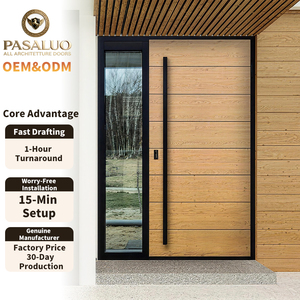
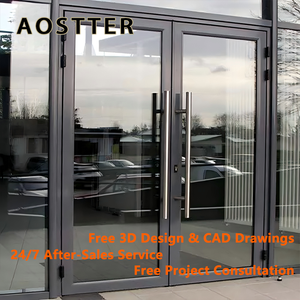
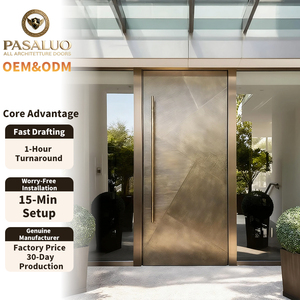
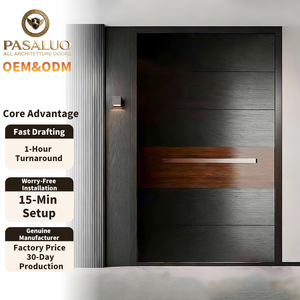
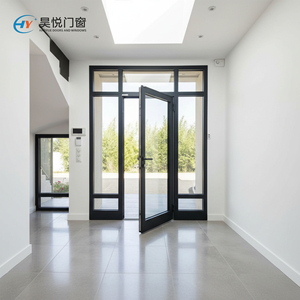
Deep-Dive Technical Analysis: The Engineering Behind Custom OEM Aluminium Front Doors
In modern architectural engineering, the front entry entrance system serves as both the primary visual statement of a property and its first line of thermal and structural defense. As modern building codes enforce stricter energy metrics and impact resistances—such as North American NFRC (National Fenestration Rating Council) standards and Australian AS2047 specifications—traditional timber and hollow steel doors are increasingly replaced by high-performance aluminum extrusions.
1. Material Science: 6063-T6 Aircraft-Grade Aluminum Alloy
Our custom OEM front door systems utilize high-density 6063-T6 aluminum alloy extrusions. Compared to standard architectural metals, 6063-T6 provides an optimal balance of tensile strength, yield strength, and surface finish quality for advanced anodizing and powder coating finishes:
- Wall Thickness: Structural profiles feature wall thicknesses ranging from 2.0mm to 3.0mm, exceeding industry standards to guarantee frame rigidity under extreme wind loads and preventing thermal racking over years of heavy cycling.
- Corrosion Resistance: High resistance to marine atmospheric corrosion makes our entry doors ideal for coastal regions exposed to salt air and high humidity.
- Dimensional Stability: Unlike solid wood doors that warp, swell, or split under humidity fluctuations, or steel doors susceptible to rust, precision-engineered aluminum maintains exact geometric tolerances (±0.5mm) across temperatures ranging from -30°C to +80°C.
2. Thermal Break Engineering & Insulated Glass Units (IGU)
Uninsulated metal frames act as thermal bridges, permitting rapid heat transfer between exterior environments and interior living spaces. To achieve high thermal performance (low U-Factors), our engineering team integrates structural Polyamide PA66-GF25 (25% Glass Fiber Reinforced) thermal barrier strips.
| Performance Characteristic | Standard Non-Thermal Aluminum | OEM PA66-GF25 Thermally Broken System | Acoustic & Security Advantage |
|---|---|---|---|
| Thermal U-Factor (W/m²·K) | > 4.5 W/m²·K | 1.2 - 1.8 W/m²·K | Up to 65% energy loss reduction |
| Acoustic Insulation (STC) | 22 - 26 dB | 38 - 45 dB | Superior noise dampening in urban zones |
| Structural Wind Load | 1.5 - 2.5 kPa | 4.5 - 6.0 kPa (Hurricane Grade) | High resistance to atmospheric pressure |
| Glass Configuration | Single Monolithic Tempered | Double / Triple Glazed Low-E + Argon | Laminated anti-burglary / impact glass |
3. Multi-Point Security & Hardware Integration
Commercial and residential security demand robust locking mechanisms. Our customized OEM front doors are engineered with multi-point stainless steel German-style hardware systems (e.g., GU, HOPPE, SIEGENIA, and custom concealed pivot hinges). The multi-point latching system locks the sash into the outer frame at 3 to 5 distinct points simultaneously upon door engagement, drastically elevating anti-pry and forced-entry performance.